

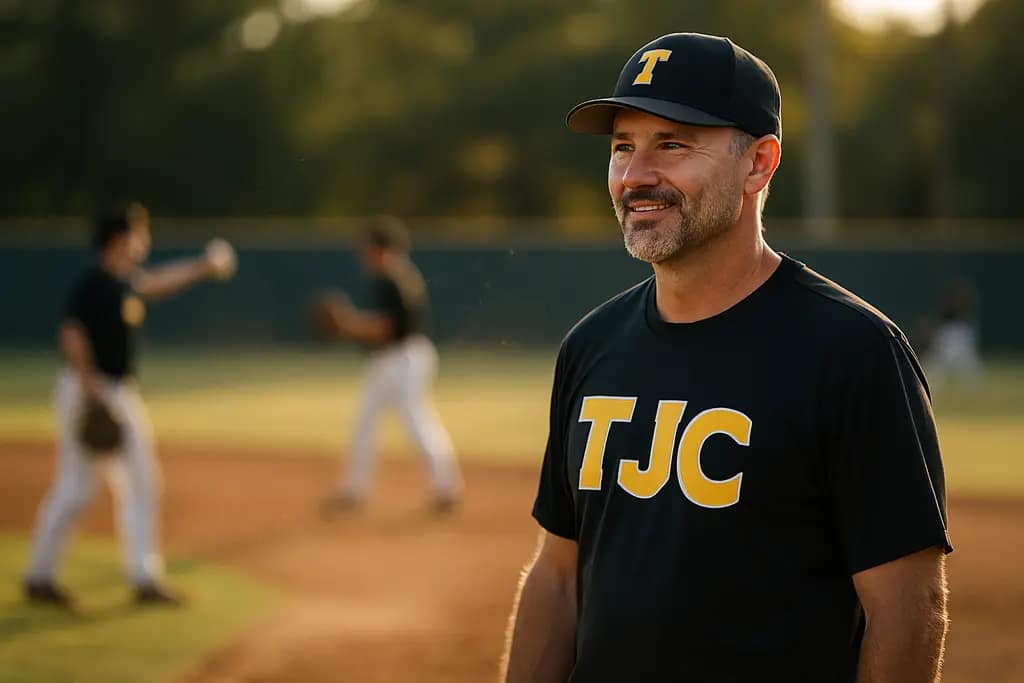
The TJC Baseball Vision under Trevin Sonnier began with a clear message on August 13, 2026: Tyler Junior College does not need a tear-down, but it does need a coach who can protect the standard, strengthen player development and connect the program more deeply to East Texas. Sonnier was named the fifth head baseball coach in TJC history in July 2026 and was formally introduced by Athletics Director Doug Wren on August 13, 2026, according to KLTV’s report from Tyler.
That context matters because Tyler Junior College is not a rebuilding job in the usual sense. The Apaches went 33-22 in the previous season, and the program has won five national championships since 2014. Sonnier stepped into a chair with expectations already attached: win, move players on, recruit well, keep the culture steady and make Tyler feel invested in what happens at the ballpark.
Why The TJC Baseball Vision Starts With Continuity
Respecting What Brett Doe Left Behind
Sonnier’s early comments pointed toward continuity rather than a public reset. He praised former coach Brett Doe and spoke about building from the program’s existing success. That is the right tone for a junior college program with TJC’s recent standard. Coaches at this level inherit players with short competitive windows, so large culture swings can create unnecessary friction. Sonnier’s stated approach gives returning players a clearer bridge from the prior staff to the next one.
The most revealing part of his introduction was not a promise of instant change. It was his emphasis on the “1%” daily improvement idea and on keeping standards intact. In baseball terms, that can show up in small areas that decide junior college games: strike-zone discipline, defensive routine plays, bullpen role clarity, catcher-pitcher communication and practice habits that survive long travel weeks.
What TJC Baseball Vision Means Day To Day
The TJC Baseball Vision sounds less like a slogan and more like a daily operating plan. Sonnier has described team culture, shared purpose and people as central themes. That matters at Tyler because the roster will always be moving. Junior college coaches are teaching the game while also preparing players for four-year opportunities. The best programs do not treat those goals as separate. Winning and advancement are tied together when players develop routines that larger programs trust.
There is still some uncertainty because the reporting provided did not include a fall roster breakdown, a full assistant staff plan or a 2027 schedule. What is supported is the direction: Sonnier wants TJC to remain nationally competitive while keeping the program connected to the people around it.
Player Development Is The Strongest Evidence Point
Howard College Results Travel To Tyler
The clearest measurable piece of Sonnier’s résumé is the player movement from Howard College. During his three seasons there from 2023 through 2025, he maintained a winning record each season and coached 41 student-athletes who transferred to four-year institutions, including 24 who went to NCAA Division I programs, as reported by AOL’s coverage of the hire. For TJC, those numbers fit the exact job description: compete now while helping players reach the next level.
That transfer record also helps explain why Sonnier’s recruiting message should have traction. Prospects and families in Texas junior college baseball tend to ask direct questions. Who has moved on from your program? What level did they reach? How do you develop players in two years or less? Sonnier arrives with answers that are recent and easy to understand.
The data point is especially relevant because TJC already has reputation on its side. Sonnier has cited TJC’s facilities, school quality and sustained standard of excellence as reasons prospective players are interested. His job now is to match that reputation with a player plan that can be repeated across classes.
Recruiting In East Texas And Region XIV
Sonnier’s East Texas familiarity gives the hire local weight. He played at Panola College, has ties to Region XIV and is originally from Nederland, Texas. He also has coaching experience at Abilene Christian, Oral Roberts and Dallas Baptist, while his playing path included Panola, Dallas Baptist and Oral Roberts.
That background creates a useful recruiting blend. Panola gives him junior college credibility in East Texas. Dallas Baptist and Oral Roberts connect him to serious college baseball environments. Abilene Christian adds another Texas stop. None of that guarantees wins at TJC, but it gives him a network that fits the job.
For a wider Texas context, the regional coaching market has been active beyond Tyler, and the Sean Allen Lamar hire offers another example of how staff moves can affect recruiting conversations across the state. TJC’s advantage is different: it can point to national titles, facility appeal and a direct junior college development mission.
Community Roots Are More Than A Talking Point
Why Tyler Buy-In Matters
Sonnier said he wants to plug into the Tyler community, plant roots and build shared purpose. That matters because junior college baseball can be overlooked by casual fans unless the program makes itself part of local sports life. Tyler has a strong enough baseball identity to support a winner, but connection is earned through consistency: camps, local relationships, family-friendly game environments and visible investment from the staff.
The TJC Baseball Vision depends on that local connection because recruiting is not only about facilities and wins. Families want to know whether a coach is staying, whether the program environment is stable and whether the school has a clear plan for young players. Sonnier has spoken about longevity for coaches and players. In a level of baseball known for movement, that message is meaningful.
There is also a practical side. Players who feel rooted tend to handle adversity better. A midweek loss, a role change or a slow offensive stretch can break focus if the team is only tied together by talent. Shared purpose gives a staff a better chance to coach through those moments without losing the room.
Facilities, Standards And Recruiting Confidence
Sonnier’s comments about TJC’s facilities and reputation point to a recruiting pitch that is already in place. He is not selling a dream without evidence. He is selling a program that has won five national championships since 2014 and is coming off a 33-22 season. The task is not to convince players TJC can win. The task is to convince them that the next version of TJC baseball is still the right fit under a new head coach.
That is where player development and community culture meet. A prospect can be drawn by facilities, but he stays invested through coaching, daily feedback and a clear path. Sonnier’s Howard College transfer numbers are useful here because they make the development pitch measurable.
How The TJC Baseball Vision Will Be Judged In Tyler
The TJC Baseball Vision will be judged by more than Sonnier’s introductory press conference. The first real markers will be how returning players respond, how recruiting interest turns into commitments, and how quickly the staff sets a standard that looks familiar to a program used to winning. Because the available reporting does not include early game results under Sonnier, it would be unfair to grade the on-field product yet.
What can be evaluated now is fit. Sonnier brings junior college head coaching success, a recent transfer record, East Texas familiarity and a stated desire to stay connected to Tyler. Those pieces match the needs of a program that already has national credibility but cannot stand still.
For Tyler Junior College supporters, the most encouraging sign is that Sonnier has not framed the job as a rescue mission. He has framed it as stewardship with daily improvement. That is a smart starting point for a program with championships in the recent record, a winning season directly behind it and a recruiting base that expects results. If the people-first message becomes visible in practices, player movement and local engagement, TJC can keep its identity while giving Sonnier room to put his own stamp on the program.