

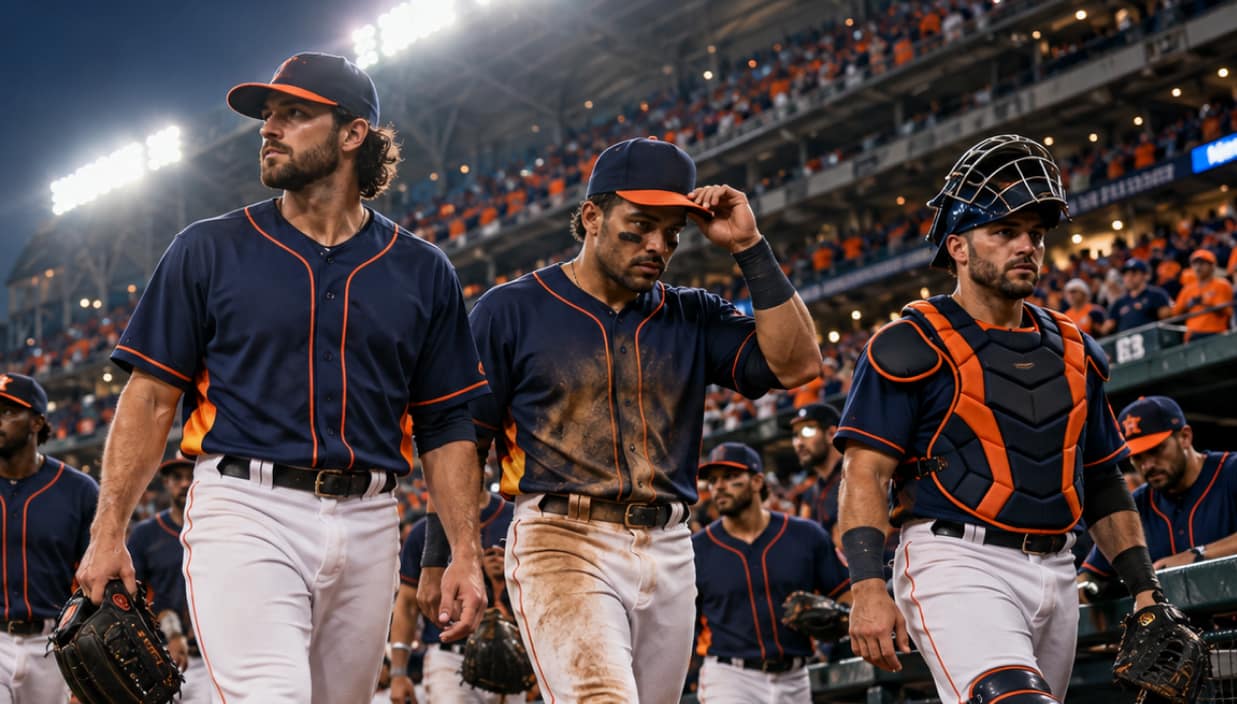
Astros Roster Grit became more than a clubhouse phrase during Houston’s 2026 playoff push. It showed up in games when the club had already given opponents control, in bullpen innings that stopped damage, and in contributions from players outside the most familiar names on the roster. For a Texas baseball audience, that matters because Houston’s standard is not measured only by star power. The Astros have spent years expecting October-level answers from the entire roster, and the 2026 group provided several clear examples of accountability under pressure.
The facts from June and July told a specific story. Houston did not simply win comfortable games behind early offense. The Astros came back from steep late deficits, leaned on a bullpen that had corrected an earlier rough stretch, and got meaningful plays from younger players, defenders and veteran bats. That mix is what separates a talented roster from one that can survive the uncomfortable parts of a playoff race.
Astros Roster Grit In Late-Inning Games
The June 4 Comeback Set A Public Standard
On June 4, 2026, the Astros delivered their biggest comeback of the season against Pittsburgh. Houston trailed 9-5 with two outs and nobody on base in the eighth inning, and the Pirates held a 98% win probability before the Astros rallied to win 11-9, according to MLB.com’s recap. Manager Joe Espada praised “the fight in this group” and said the team “never quit,” which fit the way the inning unfolded.
That game mattered because it gave the roster a shared reference point. Every team talks about staying engaged until the final out, but Houston had a recent, specific example it could point to during the next hard inning. The rally also reduced the gap between message and action. A manager’s accountability standard carries more weight when players have already shown they can answer it in a game that looked lost.
The Angels Rally Reinforced The Pattern
On July 28, 2026, the Astros added another late-game marker against the Angels. Houston trailed after eight innings and had only one hit entering the ninth, yet scored four runs to win 6-4. The context made the result sharper: before that victory, the Astros had been 3-48 when trailing after eight innings. One win did not erase that larger record, but it did show a team pushing back against a weakness rather than accepting it as part of its identity.
That is where Astros Roster Grit carries value in roster analysis. It is not a claim that Houston suddenly became automatic in the ninth inning. It is evidence that the club had enough at-bat discipline, bench belief and late-inning calm to turn poor game position into a win. In a September race, those wins can keep a clubhouse from spiraling after a flat first eight innings.
Bullpen Accountability Changed The Game Flow
A Reset After An Earlier Rough Stretch
The Astros’ bullpen turnaround gave the lineup room to rally. From May 15 onward, Houston relievers combined for a 2.66 ERA, the third-lowest mark in MLB during that span, after an earlier period in which their ERA had been the highest. On June 27, 2026, in Detroit, the bullpen held the Tigers scoreless for 5 1/3 innings to preserve an 8-6 comeback win, as noted in the Houston Chronicle’s game recap.
That kind of bullpen response is one of the clearest forms of roster accountability. Relievers cannot hide behind season-long narratives once the phone rings. They inherit traffic, protect thin margins and often decide whether a comeback becomes a win or a footnote. Houston’s improvement after May 15 showed correction, not just survival.
Detroit Showed The Offense And Bullpen Working Together
The June 27 game also tied the bullpen’s progress to the lineup’s late execution. Jeremy Peña tied the game during a two-out rally in the eighth inning, and Isaac Paredes followed with a two-run double that gave Houston its first lead since the third inning. The bullpen then carried the final stage of the result.
That sequence matters because accountability is rarely limited to one position group. The offense had to produce after the game had leaned Detroit’s way. The bullpen had to make the lead stand. The win was not built on one dramatic swing alone; it required a chain of professional innings from hitters and relievers. That is the kind of connected baseball Houston needs from a roster with postseason expectations.
Accountability Beyond The Middle Of The Order
Yordan Alvarez Gave Houston A Star-Level Baseline
Yordan Alvarez supplied the kind of production that stabilizes a team during a playoff push. By July 5, 2026, he led the American League in home runs with 29, RBIs with 67, extra-base hits with 45 and MLB OPS at 1.078. He was voted to start at designated hitter for the American League in the 2026 All-Star Game. By August 7, he was hitting .329/.442/.640 with 35 home runs and 85 RBIs, leading the AL in all three Triple Crown categories.
For Houston, Alvarez’s season created a clear offensive anchor. Yet the more useful roster lesson is that even a season like that cannot carry a playoff push alone. A star can set the standard, but the surrounding roster has to protect that work by adding baserunners, defending late leads and absorbing the uneven nights every club faces.
Astros Roster Grit From Young Contributors
The late-June road trip through Toronto and Detroit, which ended on June 28, gave Houston that wider roster involvement. The Astros won five consecutive series for the first time since June 20-July 6, 2025. Contributions came from multiple levels of the roster, including Isaac Paredes, Christian Walker, Raynel Delgado’s first career homer and key defensive plays.
Delgado’s first career home run on June 28 against Detroit stood out because young players often reveal a roster’s health. If they are only asked to fill innings quietly, the ceiling is limited. If they can affect winning moments, the roster has more ways to withstand fatigue, injury stress and matchup pressure. Brice Matthews’ run-saving catch and Houston’s key double plays during that stretch added the same point on defense: accountability is not just what happens in the batter’s box.
Why Accountability Carries Weight In Texas Baseball
Espada’s ABS Approach Fits The Same Theme
Espada’s approach to automated ball-strike challenges gave another window into how Houston treated accountability. Players were encouraged to use ABS challenges when warranted rather than defaulting to hesitation or guesswork, and the team tracked “runs gained” from challenges to guide decisions. As of June 20, 2026, Houston hitters had the second-best success rate in overturns at roughly 56% and ranked second-highest in run value gained as the hitting team.
That detail may seem small next to a four-run ninth inning, but it fits the same roster profile. Good teams look for controllable edges. They do not leave every decision to feel, and they do not ask one star to solve everything. Houston’s ABS results showed that the club was turning a new competitive tool into game management discipline.
The Local Lens Is About Standards
Houston fans have watched enough contending baseball to know the difference between noise and substance. Comeback wins are memorable, but the deeper question is whether the behavior behind them repeats. The Astros’ June and July stretch offered evidence of repeatable habits: two-out offense, reliever correction, defensive attention and younger players producing in real games.
That is also why roster trust remains central to how the club is judged in Texas. The organization’s choices around the major league group connect directly to how much responsibility the clubhouse can carry, a theme that also appeared in our analysis of Houston’s trade deadline strategy. A club that trusts its core still needs proof from the edges of the roster, and Houston received several of those proofs during the summer.
What Astros Roster Grit Means For Houston
As of September 21, 2026, the cleanest reading is not that Houston had solved every late-game problem. The 3-48 record before the July 28 Angels comeback showed that trailing after eight innings had been a serious issue. The value came from the response: the Astros produced a ninth-inning rally, had already staged the June 4 comeback against Pittsburgh, and had seen their bullpen reshape games after a difficult earlier stretch.
Astros Roster Grit, in this case, is best understood as a roster-wide pattern. Alvarez gave Houston elite production. Peña and Paredes supplied late offense in Detroit. Relievers turned a weakness into a strength from May 15 onward. Delgado and Matthews added evidence that the younger part of the roster could do more than watch veterans carry the race. For a Houston team measured by postseason standards, that shared responsibility is the most meaningful part of the push.