

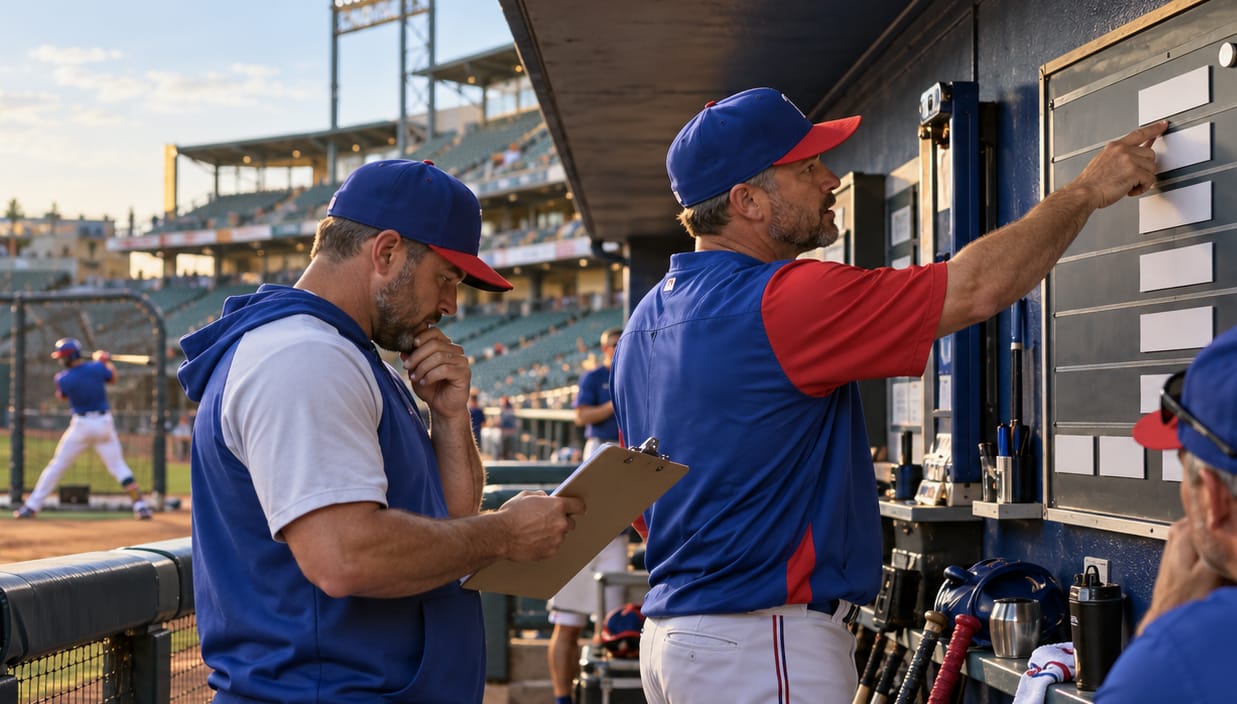
As of September 21, 2026, Personalized Batting Orders are one of the clearest windows into Skip Schumaker’s first full-year offensive thinking with the Texas Rangers. The idea was not simply moving big names around a card. It was a season-long attempt to place hitters in spots where their strengths, the opposing pitcher’s handedness and the game state could meet more often.
That approach fits the local baseball conversation in Arlington because Rangers fans have watched this roster win with star power, then wrestle with how to keep an offense steady across injuries, matchups and long divisional stretches. Schumaker’s plan asked a familiar Texas question in a new way: how can a lineup with Corey Seager, Wyatt Langford, Brandon Nimmo, Jake Burger, Josh Smith and Justin Foscue create pressure without becoming too dependent on one swing?
For more context on the manager’s broader decision-making style, our previous breakdown of Skip Schumaker leadership for Texas connects his front-office background and Marlins experience to the daily demands of managing in Arlington.
Why Personalized Batting Orders Fit Schumaker
A Batting Order Built Around Sequencing
On March 9, 2026, Schumaker described a plan to build the top half of the Rangers’ order around an alternating left-right structure. The reported shape had Brandon Nimmo at leadoff, Wyatt Langford in the No. 2 spot, Corey Seager third and Jake Burger in the cleanup slot. The bigger takeaway was not that every lineup would look identical. It was that Schumaker wanted the opposing dugout to face fewer clean lanes for bullpen matching.
That matters in the American League West, where repeat meetings give opponents a long memory. If a manager stacks similar hitters together, a rival bullpen can sometimes attack one pocket of the order with a single matchup arm. Schumaker’s preferred top-half spacing showed he was thinking two innings ahead, not just picking the four best hitters and writing them in a traditional order.
Personalized Batting Orders And Player Strengths
Personalized Batting Orders also matched the December 2025 offensive messaging around new hitting coach Justin Viele and the staff. The stated goal was helping position players understand what they did best, then assigning a lineup spot or task that let those traits show up. In the research notes, Cody Freeman was tied more closely to contact, while Jake Burger was tied to damage.
That distinction is useful. Contact and damage are not competing goals if a lineup is arranged with purpose. A contact-oriented hitter can extend an inning for the power bat behind him. A damage hitter can justify a central run-production slot because the surrounding hitters are built to supply traffic. In that setup, the batting order becomes part of player development rather than a public ranking of status.
The Data Points Behind The Lineup Choices
Why Seager’s Move Was Not A Demotion
Seager’s move from the No. 2 spot to the No. 3 spot was one of the cleaner examples of separating role from reputation. The change was tied to the alternating structure, not a major performance drop. The research showed Seager had a .884 OPS over 85 games batting third, compared with an .870 OPS in the No. 2 spot.
That is the kind of split that should calm the temperature around lineup debates. A star hitter changing slots does not always signal concern. In this case, the numbers supplied enough support for Schumaker to treat Seager as a lineup anchor in a slightly different position. For a Texas offense trying to balance several high-value bats, that flexibility had value beyond one plate appearance in the first inning.
Josh Smith And The Value Of Consistent At-Bats
Josh Smith became another useful example on June 18, 2026, when Schumaker explained why Smith was being placed in the middle of the order during a run of six straight right-handed opposing starters. Schumaker expected Smith to benefit from those opportunities against right-handed arms and pointed to the value of consistent at-bats.
That choice says a lot about Schumaker’s coaching philosophy. Smith was not just filling an empty line on the card. He was being positioned for a defined stretch of opponents. That is player trust with boundaries: the manager identifies the matchup window, gives the hitter regular work and then evaluates the response.
The same theme appeared on June 7, 2026, after a game against the Guardians. Schumaker emphasized seeing the ball up, being selective and avoiding chase after Wyatt Langford returned to the lineup, framing the Rangers’ offensive standard around high-quality at-bats.
Matchups, Health And Order Stability

June 26 Showed How Quickly Plans Can Shift
Lineup theory only works if the available roster cooperates. On June 26, 2026, Seager was activated from the 7-day concussion injured list ahead of a series against the Blue Jays. His return gave Schumaker more ways to arrange the top half of the order, especially with a left-handed starter in the matchup picture.
The research notes from that date showed a reshuffled look: Langford at leadoff, Seager second and fewer left-handed hitters pushed together down the order. That kind of adjustment was not random. It reflected the same matchup logic from March, only with a different player-availability puzzle.
For fans watching from Arlington, these changes can feel abrupt on a nightly basis. One day a player is batting third, another day he is leading off or sitting in a different pocket. Schumaker’s pattern suggests those decisions were connected by opponent handedness, expected traffic on base and the desire to avoid predictable clusters.
Foscue’s Spot Highlighted Run-Scoring Timing
A lineup plan discussed around September 4, 2026, brought Justin Foscue into the same conversation. Schumaker addressed where to bat Foscue so he would be more likely to come up against left-handed pitchers with runners on base, reducing wasted plate appearances.
That is a more specific idea than simply starting a hitter because the matchup is favorable. It asks where the matchup is most likely to matter. A right hitter who fits well against left-handed pitching can still be underused if his plate appearances come with empty bases and two outs. Schumaker’s comments around Foscue showed an interest in timing the skill to the inning context.
By mid-September 2026, Schumaker had also praised the Brewers as a model for the offense he wanted: a group that did not chase, ran the bases well, put the ball in play and created different scoring paths. At that point, Texas stood 66-68 and remained in the AL West race, so the lineup choices were not abstract coaching talk. They were tied to a club still trying to squeeze value out of every matchup.
What Personalized Batting Orders Mean In Arlington
Personalized Batting Orders matter in Arlington because the Rangers’ offensive ceiling depends on more than one superstar carrying a week. Seager’s slot, Langford’s usage, Smith’s run of starts against right-handed pitching, Burger’s damage profile and Foscue’s matchup timing all point to a manager trying to spread responsibility across the card.
The strength of that plan is clarity. Hitters know why they are being used, not just where they are hitting. A player asked to make contact is not being judged by the same offensive standard as a player asked to drive the baseball. A hitter moved lower in the order may still be placed in a spot where the opposing pitcher and base-state pattern fit his strengths.
The risk is that constant adjustment can look unstable if the results do not follow. Texas fans are patient with a plan when the at-bats match the explanation: fewer chase swings, better counts, pressure on the bases and run-scoring chances created across multiple innings. They are less patient when matchup logic produces a quiet night and the order seems to change again the next day.
That is why Schumaker’s 2026 philosophy should be judged by process as much as by any single lineup card. The verified examples from March through September showed a consistent thread: alternate where possible, protect hitters from poor matchup clusters, reward skill-specific roles and keep the offense focused on quality at-bats. For a Rangers team rooted in a demanding Texas baseball market, Personalized Batting Orders became less about novelty and more about whether the club could turn individual hitter strengths into steadier run production.