

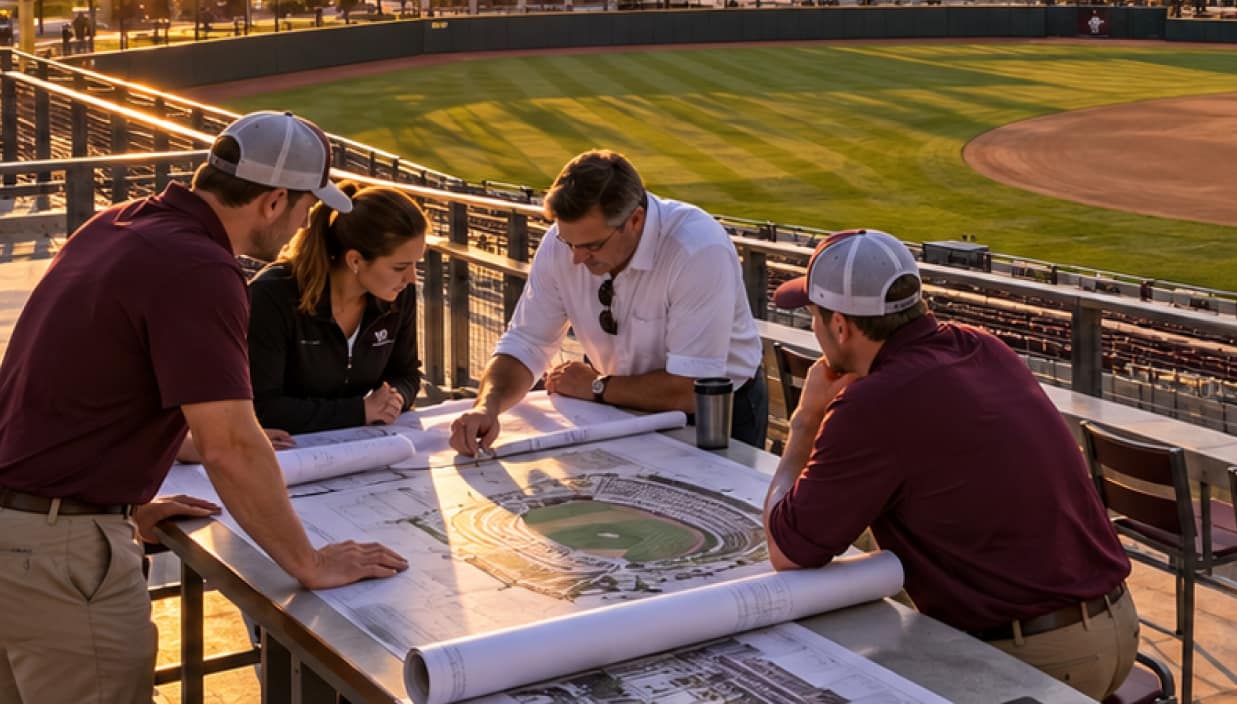
Olsen Field Renovations matter because Texas A&M baseball is treating facility investment as a coaching and player-development issue, not only a stadium project. As of September 10, 2026, the public record available in the research points to a phased plan at Blue Bell Park: first, a player-centered buildout tied to training, recovery and daily instruction; then broader stadium upgrades aimed at seating, concourses, restrooms and food service. For a program competing in the SEC, that distinction matters. The facility plan is as much about what happens on a Tuesday practice day as it is about what fans see on a Friday night in College Station.
What Olsen Field Renovations Put In Motion
Olsen Field Renovations And The Approved Scope
The earliest documented step came in November 2022, when the Texas A&M University System Board of Regents approved adding the Olsen Field at Blue Bell Park Renovations Project, Project No. 02-3403, to the FY 2023–2027 capital plan with a $60 million planning amount and an anticipated FY 2025 start, according to the Nov. 2022 regents agenda. Later materials cited in the research updated that planning amount to $80 million and shifted the projected start to FY 2026.
That shift is significant for coaches because it places the work closer to the years in which Texas A&M was resetting baseball operations under head coach Michael Earley. Facility timelines rarely line up cleanly with roster cycles. A recruiting class can be signed before a building opens. A transfer can be evaluating a program while construction is still being phased. That makes the messaging around a project almost as important as the project itself: coaches have to explain not only what exists, but what is funded, approved and expected to become part of the player experience.
Why The Player Development Center Came First
The clearest player-facing piece was the $28.3 million Player Development Center portion approved by the Regents on February 6, 2025. WTAW reported that the segment included new batting cages and a pitching lab, strength and conditioning and sports medicine areas, meeting rooms, a home clubhouse, locker rooms, recovery spaces, and replacement of field lighting and the playing surface through its Blue Bell Park project report.
That list says plenty about the coaching priorities behind Olsen Field Renovations. Batting cages and a pitching lab change how a staff can structure individual work. Strength, conditioning, recovery and sports medicine spaces affect how players move through a week between SEC games. Meeting rooms give coaches more room to separate hitters, pitchers, position groups and full-team preparation without forcing every teaching moment into the same space.
Public research notes said construction on the Player Development Center phase was expected to begin in summer 2025 after Texas A&M concluded its 2025 home schedule. Because the available research does not confirm every completion detail by September 10, 2026, the safer reading is that the project should be judged as a phased infrastructure plan rather than a single switch that was flipped at one moment.
Coaching Value Inside The Building Plan
Practice Design And Daily Skill Work
Baseball facility spending can sound abstract until it is tied to a practice plan. A hitting space allows more controlled swing work when weather, class schedules or field availability get tight. A pitching lab can support bullpen feedback and pitch-design work if the staff has the equipment and staffing to use it well. A dedicated strength area helps keep training closer to baseball operations rather than making development feel split across campus.
For a coach, the facility question is not only whether a recruit is impressed during a visit. It is whether the staff can build better daily habits after that player enrolls. If a freshman hitter needs extra cage reps, the building can create more time windows. If a pitcher needs recovery attention between outings, sports medicine and recovery space can shorten the gap between diagnosis, treatment and return to throwing. If a position group needs video or meeting work, dedicated rooms give the staff a cleaner teaching schedule.
Recruiting Conversations In Texas And Beyond
Recruiting was directly attached to the project in local reporting. Athletics Director Trev Alberts said Coach Earley considered the player development facility his “number one priority” to help Texas A&M “keep, maintain and recruit the best athletes in the country,” according to WTAW’s report on the Regents approval.
That comment matters because it connects the building plan to the staff’s competitive task. Texas A&M is not recruiting in a quiet baseball market. The Aggies are selling College Station against SEC programs with major baseball investment, while also trying to retain players once they are on campus. A facility can help with both ends of that cycle if it gives players a clear development path and gives families confidence that the program is investing in instruction, health and preparation.
There is a staff-building layer here, too. Better spaces can help assistants teach more efficiently, separate player groups when needed and create a clearer identity around development. That lines up with the broader recruiting reset around Aggie baseball; staff connections, evaluation habits and facility promises all meet during campus visits. For more on that staff-recruiting connection, the recent piece on how Nolan Cain resets Aggies recruiting fits naturally beside the facility discussion.
Fan Demand And Stadium Operations At Blue Bell Park
Amenities Match The Program’s Revenue Needs
The broader $80 million renovation scope in the research includes premium seating, improved concourses, restrooms, additional reserved seating and enhanced food service areas. Those items are not player-development tools in the narrow sense, but they can still affect baseball operations. Better premium and reserved seating can support ticket revenue. Improved concourses, restrooms and food areas can make high-demand nights easier for families and longtime season-ticket holders. In college baseball, where revenue streams are smaller than football, those stadium details can feed back into what a program can support around staff, travel, recruiting and operations.
Blue Bell Park already carries a distinct College Station identity. The challenge for Texas A&M is balancing that local feel with SEC-level expectations. Fans want a ballpark that still feels like Olsen Field. Coaches want a building that helps win games. Administrators have to phase construction around home schedules, budgets and donor priorities. The project sits at the intersection of all three.
Lighting And Playing Surface Carry Baseball Value
The player-centered phase specifically included replacement of field lighting and the playing surface. Those details can be easy to overlook because they are less visible than a clubhouse rendering or premium seating area. For players and coaches, they are central to everyday baseball. Lighting affects night-game conditions, defensive reads and practice flexibility. Playing surface quality affects ground-ball work, baserunning, outfield reads and the physical load on athletes across a long season.
Those upgrades do not guarantee wins. They do reduce avoidable friction. A better-lit, better-conditioned field gives coaches a cleaner setting for repetition. In a sport built on repeated skill work, that matters. Small facility advantages can show up over months rather than one weekend: cleaner practices, fewer schedule disruptions, better recovery routines and more consistent teaching environments.
What Olsen Field Renovations Mean For Future Seasons
The Best Read For 2026 And After
For future seasons, the main takeaway is that Texas A&M has tied baseball infrastructure to the full program model: player development, recruiting, staff workflow, fan amenities and revenue potential. The public documents and local reporting support that reading. They do not support claiming that every planned element was fully complete by September 10, 2026, so any evaluation should separate approved scope from confirmed finished work.
If the player development spaces become fully functional as intended, the Aggies should have stronger tools for individualized instruction. If the broader stadium amenities are phased in as planned, Blue Bell Park should have more ways to serve both high-end ticket demand and everyday fan comfort. Neither outcome replaces evaluation, coaching or roster management. Facilities do not identify hitters, develop pitchers or manage SEC weekends by themselves.
Still, Olsen Field Renovations give Texas A&M a clearer platform for the work Michael Earley’s staff is trying to sell and teach. In a league where small margins stack up quickly, upgraded training space, recovery support, meeting rooms, lighting, field surface and fan-facing amenities can all push the program closer to the standard it is chasing. The real measure will come across future recruiting cycles and SEC seasons, when the facilities are judged less by their price tag and more by whether they help the Aggies develop better players and sustain stronger baseball in College Station.