


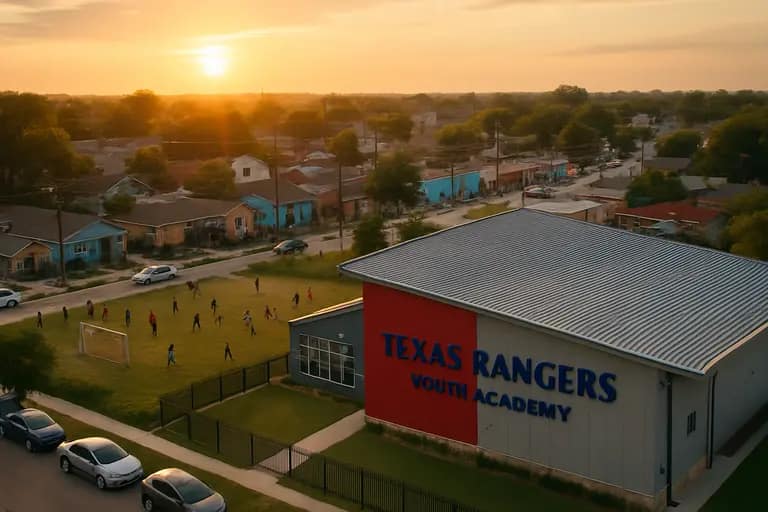
The Rangers Youth Academy gives Texas baseball a local development model that can be measured in access, facilities, college opportunities and community reach. Opened officially on December 19, 2017, at the Mercy Street Sports Complex in West Dallas, the 17-acre site became part of MLB’s Urban Youth Academy network and has served players in a part of Dallas where cost and field access can shape who gets steady baseball and softball instruction official academy page.
For a player development analyst, the most useful part of the academy is not a single headline tournament win or one college signing. It is the structure: no-cost programming for ages 7–18, repeated seasonal instruction, indoor and outdoor training space, summer Nike RBI League play, recruiting education and off-field support. That type of setup does not guarantee prospects. It does, though, increase the number of local athletes who can stay in the sport long enough to be evaluated, coached and placed in competitive environments.
How Rangers Youth Academy Access Shapes Development
Rangers Youth Academy Access Starts With Cost
The academy’s no-cost model matters because baseball and softball development can become expensive quickly. Private lessons, tournament travel, strength training, gear and recruiting events can split players by household resources before coaches ever compare tools. The academy’s stated age range of 7–18 gives families a longer runway, from early skill exposure through high school recruiting years.
The program format also helps. The research record identifies four seasonal five-week programming sessions each year — winter, spring, summer and fall — along with a free Nike RBI League during the summer window from mid-May through July. That cadence is useful because player growth depends on repeated feedback, not one camp weekend. A hitter can return for another round of cage work. A pitcher can revisit command and body control. A softball player can move from basic reps into game-speed decision-making as she matures.
Facilities Create More Reps In West Dallas
The physical buildout gives coaches more ways to teach. The facility includes five baseball and softball fields, an indoor training facility with a full-size infield, six batting and pitching cages, classrooms, a nutrition room, locker rooms, a weight room and other support areas, according to the project profile from CREDE Group facility project profile.
That mix matters in North Texas because weather, school schedules and transportation can interrupt development. Indoor space can protect a throwing session from heat or rain. Classrooms make recruiting and leadership education part of the same building as field work. A nutrition room and weight room do not make young players college-ready by themselves, but they introduce habits that older athletes need once the game speeds up.
- Five baseball and softball fields support game play and team instruction.
- Six batting and pitching cages create repeatable skill work.
- Classrooms support recruiting, education and leadership programming.
- Weight room and nutrition areas connect physical preparation to baseball and softball routines.
What The Numbers Say About The Pipeline
College Commitments Give The Clearest Public Marker
The most concrete public development marker in the research is the college pathway. Since opening, the academy had recorded more than 110 athletes committing to play baseball or softball at the collegiate level as of April 12, 2024. That number does not tell us each athlete’s role, scholarship level or future playing time, so it should not be stretched beyond what it says. Still, for a no-cost academy serving youth players in Dallas, 110-plus college opportunities is a meaningful indicator.
The 2025 academy update added another useful checkpoint. Kaleb Thompkins, a DeSoto native, was named the academy’s 2025 Youth of the Year on October 10, 2025, for excellence on and off the field. That same update identified seven 2026-class academy athletes who had committed or signed with collegiate baseball or softball programs. For local families, those examples connect the program to a real recruiting outcome rather than a general promise of exposure.
Tournament Results Show Competitive Translation
The academy’s elite baseball team also produced a national-level result on July 13, 2026, when it won the 2026 Commissioner’s Cup with a 10-9 walk-off victory over Compton Youth Academy. One tournament result should not be treated as a full measure of a development system. A single week can swing on pitching availability, defensive execution or one late at-bat. Even so, winning that event showed that the academy’s top group could compete against peers from another MLB youth academy setting.
That matters for Texas evaluators because training volume and game translation are different tests. A player can look clean in drills but struggle when a count turns stressful or a defensive play has to be made under tournament pressure. The Commissioner’s Cup result gave the program a dated, public marker that its instruction could carry into a competitive setting.
Why The West Dallas Setting Matters
Player Development Is Also A Community Question
West Dallas is not a backdrop in this story. The location is central to the academy’s value. A 17-acre baseball and softball complex in that part of the city changes the practical math for families who might not otherwise have steady access to fields, cages and trained instruction. It also puts the Texas Rangers brand into a youth setting where the major league club is not only selling fandom but supporting participation.
The academy’s off-field programming reinforces that point. The research identifies educational and leadership programs, including work with Buckner International for out-of-school enrichment, free education courses in English and Spanish, adult classes and a UMPS CARE Charities leadership-training program that certified more than 35 athletes in 2025. For young players, especially those moving toward college, those pieces can matter as much as a swing adjustment. Coaches recruit athletes who can handle school, travel, communication and accountability.
Upgrades Tied The Big-League Moment To Youth Access
The 2024 facility upgrades under the Rangers’ All-Star Legacy initiative gave the academy another layer of local significance. The research notes that the original grass field was replaced with turf using a field surface from the 2023 World Series, along with new netting, scoreboards, fencing and shade covers. Those changes connected a championship-era major league moment to a youth training site in Dallas.
That link is worth tracking because infrastructure has a long shelf life. A renovated field can host thousands of future reps after the ceremonial ribbon-cutting fades. Shade covers affect family comfort. Netting and fencing affect safety and practice flow. Scoreboards support game environments that feel more formal for players learning how to compete. For readers tracking broader facility investment, our coverage of Rangers legacy projects follows the same connection between major league resources and youth access across the region.
What Rangers Youth Academy Means For Texas Talent
The best way to view the Rangers Youth Academy is as a long-term player development base, not a prospect factory with guaranteed outputs. Its strongest verified assets are clear: a no-cost structure for ages 7–18, year-round seasonal programming, a West Dallas facility built for baseball and softball instruction, more than 110 college commitments reported by April 12, 2024, and a recent national tournament win on July 13, 2026.
The remaining uncertainty is also fair to state. Public information does not show a full year-by-year breakdown of every participant, retention rate, recruiting outcome, position group or scholarship type. Without those details, no analyst should claim the academy is producing stars at a specific rate. What can be said is that it has built a credible development pathway where more Dallas-area athletes can receive instruction, play competitive games and learn what college programs expect.
For Texas baseball, that is the central value. Talent in this state has never been limited to one suburb, one travel circuit or one income bracket. The academy gives West Dallas and nearby communities a structured place inside the broader player pipeline. If future college rosters and professional draft boards include more athletes who passed through that facility, the data trail will start with the access points already in place: fields, cages, instruction, education and the time needed for young players to grow.